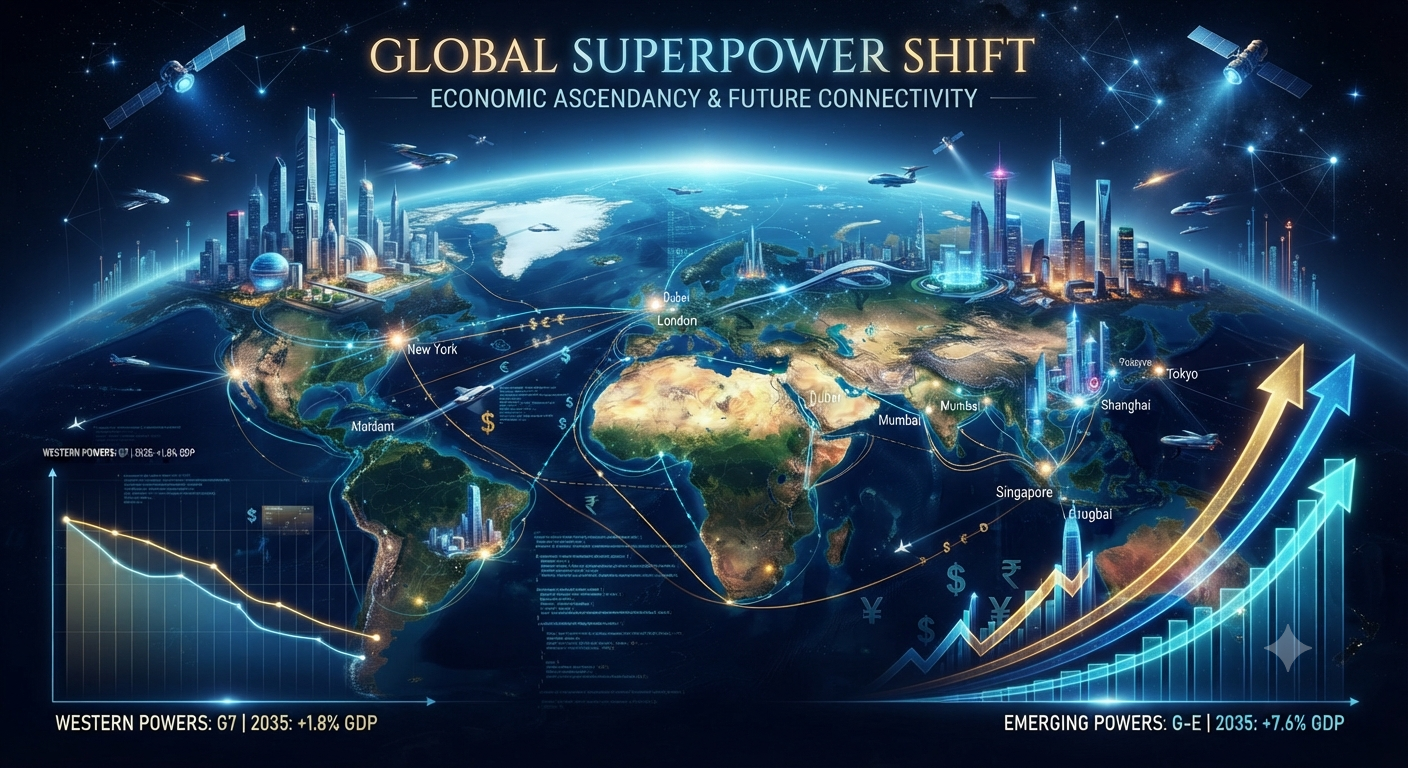

For the past eight decades, the global economic order has been defined by Western leadership. The post-World War II era established the United States dollar as the world’s primary reserve currency, while institutions like the IMF, World Bank, and G7 shaped international trade, monetary policy, and geopolitical stability.
However, the global economic center of gravity is visibly shifting.
Driven by demographic momentum, rapid industrialization, technological innovation, and expanding trade networks across the Global South, the unipolar economic model is giving way to a more fragmented, multipolar world.
As we look toward the mid-21st century, major questions emerge: Is the era of American economic dominance drawing to a close? Will China overcome its internal headwinds? How will emerging powerhouses like India reshape global commerce?
Here is an analysis of the key players and economic trends shaping the future of global leadership.
1. The United States: Resilient, But Facing Structural Headwinds
Despite frequent predictions of its decline, the United States economy remains a formidable powerhouse. It commands unparalleled capital markets, dominates global technological innovation (particularly in artificial intelligence, biotechnology, and semiconductor architecture), and possesses rich natural energy resources.
┌─────────────────────────────────────────────────────────────┐
│                 U.S. ECONOMIC POWER METRICS                 │
├───────────────────────────────┬─────────────────────────────┤
│   STRENGTHS                   │   STRUCTURAL RISKS          │
│   • Global Reserve Currency   │   • Escalating National Debt│
│   • Tech & AI Supremacy       │   • Domestic Polarization   │
│   • Deep Capital Markets      │   • Geopolitical Overreach  │
└───────────────────────────────┴─────────────────────────────┘
The Challenges Ahead:
-
Debt & Fiscal Pressure: Rising national debt obligations and persistent budget deficits constrain long-term public investment.
-
De-Dollarization Trends: While the U.S. dollar still accounts for the vast majority of international trade settlements, bilateral trade in local currencies across Eurasia and Latin America is gradually eroding its absolute monopoly.
-
Political Volatility: Shifting domestic trade policies and protectionist measures create uncertainty for global supply chains.
2. China: The Manufacturing Giant Facing Demographics
China’s economic rise over the past four decades is one of the most remarkable transformations in human history. By converting itself into the “factory of the world” and executing massive infrastructure projects via the Belt and Road Initiative (BRI), China firmly established itself as the world’s second-largest economy.
The Current Realities:
China leads globally in renewable energy hardware, electric vehicle (EV) manufacturing, and high-speed transit networks. However, its path to becoming the sole world economic leader faces significant hurdles:
-
Demographic Decline: An aging population and shrinking workforce present long-term productivity challenges.
-
Real Estate & Debt Rebalancing: Transitioning away from a debt-driven property market toward a high-value consumption economy has slowed overall GDP expansion.
-
Geopolitical Frictions: Increasing trade barriers and tech export controls from Western nations are forcing China to shift focus toward domestic self-reliance.
3. India: The Engine of Growth in the Global South
Perhaps the most dynamic shift in the global economic landscape is the rapid ascent of India. Having surpassed the UK to become the world’s fifth-largest economy, India is widely projected by global financial institutions to become the third-largest economy before the end of the decade.
Key Growth Drivers:
-
Demographic Dividend: With one of the youngest average populations among major economies, India possesses a massive, expanding workforce and consumer base.
-
Digital Public Infrastructure (DPI): Platforms like UPI (Unified Payments Interface) and Aadhaar have revolutionized financial inclusion, digital payments, and e-commerce at a scale unmatched by most developed nations.
-
Manufacturing Expansion: The push for domestic manufacturing (Make in India), combined with global corporations adopting “China Plus One” supply chain strategies, is attracting unprecedented foreign direct investment into Indian electronics, pharmaceuticals, and industrial manufacturing.
4. The Rise of Multipolarity: BRICS+ and Regional Blocs
The future of the world economy may not belong to a single superpower, but rather to a multipolar network of regional powers and trade blocs.
The expansion of economic alliances like BRICS (which includes key energy producers and emerging markets across South America, the Middle East, Africa, and Asia) highlights a growing appetite among developing nations for independent trade channels, regional currency settlements, and alternative development banking.
At the same time, regional powers such as Brazil, Indonesia, Saudi Arabia, and the UAE are asserting themselves as “swing states”—collaborating pragmatically with the West, China, and India based on national interest rather than rigid alliance lines.
What Will Define Economic Leadership Next?
In the 20th century, economic dominance was largely measured by industrial output, oil reserves, and military hardware. In the coming decades, global economic leadership will be decided by four distinct factors:
-
Technological Supremacy: Control over Artificial Intelligence, quantum computing, and advanced semiconductor manufacturing.
-
Energy Transition Leadership: Mastering green energy infrastructure, battery storage technology, and critical mineral supply chains.
-
Demographic Vitality: Maintaining a skilled, adaptable, and technologically literate workforce.
-
Institutional Trust: Offering stable legal frameworks, deep financial markets, and reliable international trade rules.
Final Thoughts
The idea that a single country will uncontestedly “rule” the global economy in the future is increasingly outdated. Instead, we are entering an era of strategic interdependence and multipolar competition.
While the United States will remain a dominant technological and financial heavyweight, its leadership will be shared alongside a rising Asian continent led by India and China. For businesses, investors, and citizens worldwide, navigating this new landscape will require adaptability, cross-cultural awareness, and an understanding of shifting global dynamics.