
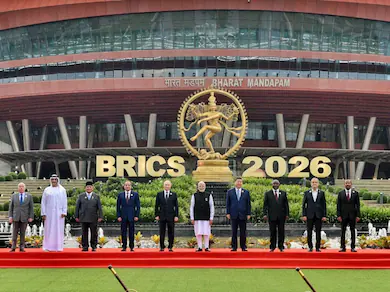

In September 2026, world leaders gathered in India for the 18th BRICS Summit under the umbrella theme “Building for Resilience, Innovation, Cooperation, and Sustainability.”
The headline achievement of the summit was the unanimous adoption of the New Delhi Declaration 2026. As the Global South takes a more active role in shaping international economic policy, this landmark agreement sets a clear agenda focused on financial architecture reform, cross-border payment integration, digital public infrastructure, and ethical AI frameworks.
Here is a breakdown of the key takeaways from the 2026 Summit and what they mean for the future of the global economy and technology regulation.
1. Local-Currency Payments and Financial Infrastructure
One of the central priorities of the New Delhi Declaration was reducing cross-border transaction costs and enhancing resilience against foreign exchange shocks.
┌─────────────────────────────────────────────────────────────┐
│                 BRICS FINANCIAL FOCUS AREAS                 │
├───────────────────────────────┬─────────────────────────────┤
│ LOCAL-CURRENCY SETTLEMENTS    │ CROSS-BORDER DISPUTE RESOL. │
│ • Expands non-dollar bilateral│ • Prioritizes mediation &   │
│   trade invoicing             │   arbitration frameworks    │
│ • Lowers conversion fees      │ • Protects cross-border MSMEs│
└───────────────────────────────┴─────────────────────────────┘
-
Non-Dollar Trade Settlement: While the summit did not create a unified single currency, member states reaffirmed their commitment to expanding trade in domestic currencies.
-
Interoperable Digital Payments: Leaders highlighted the need for seamless cross-border payment mechanisms—linking national real-time payment rails to streamline trade and remittance flows.
-
Support for MSMEs: India spearheaded the Jaipur Consensus, aiming to establish an Invoice Discounting Mechanism to unlock working capital for small and medium-sized enterprises involved in international supply chains.
2. Setting Global Standards for Artificial Intelligence and Technology
With emerging technologies reshaping industries worldwide, the 2026 Summit placed digital governance at the center of discussions. The New Delhi Declaration advocates for an accessible, trustworthy, and inclusive AI ecosystem tailored to the needs of developing nations.
Key Tech Directives from the Summit:
-
Democratizing AI Technology: Member nations emphasized that artificial intelligence should not remain concentrated in a few corporate hubs. Instead, open-source models, shared datasets, and affordable computing power must be accessible across the Global South.
-
Digital Public Infrastructure (DPI): Leveraging India’s success with open digital networks (such as digital IDs and instant payments), BRICS endorsed DPI blueprints to help developing nations modernize public service delivery.
-
Energy Grids & Smart Tech: The summit launched a Digital Centre of Excellence for Smart Grids, using AI tools to optimize renewable energy integration into national power networks.
3. Resilient Global Supply Chains and the GVC Action Plan
To buffer member economies against global supply disruptions, BRICS adopted the Global Value Chain (GVC) Action Plan 2026–2030.
-
Green Tourism & Transport Hubs: The summit instituted initiatives like the BRICS Urban Mobility Hub and the Sustainable Aviation Fuels Forum to green global supply lines.
-
Agricultural Resilience: To safeguard food security, leaders announced plans for a BRICS Grain Exchange (targeted for 2027) alongside the BRICS AGRIN network to manage agricultural inputs and genetic resources sustainably.
4. What the New Delhi Declaration Means for Global Governance
Beyond economics and technology, the 2026 Declaration presented a structured roadmap to reform traditional international institutions—such as the United Nations Security Council, IMF, and World Bank—based on the principles of Representation, Responsiveness, and Rule-making.
By serving as a bridge between emerging markets and established global powers, India’s host role reinforced a vision of international diplomacy that shifts global governance from a “pyramid of privilege” to a “platform of partnership”.
Final Thoughts
The 18th BRICS Summit made it clear that the future of international trade, digital governance, and economic resilience will be shaped by multilateral collaboration. By aligning on local currency frameworks, shared AI standards, and resilient value chains, the New Delhi Declaration 2026 provides a pragmatic blueprint for growth across the Global South.