
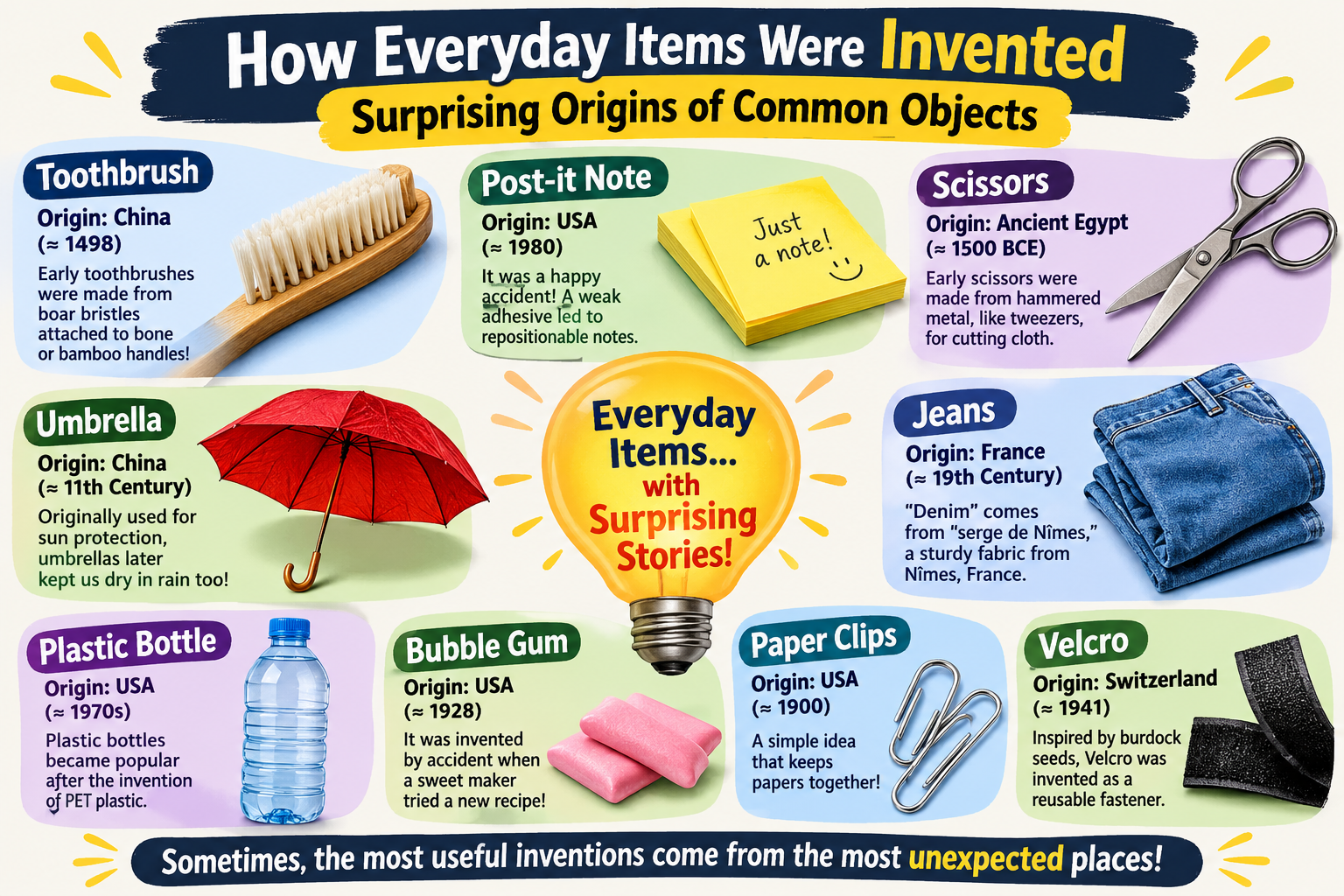

We use dozens of household items every single day without giving them a second thought. From brewing our morning coffee to sticking a note on the refrigerator, these objects feel so natural to our daily routine that it seems as if they have always existed.
However, the history behind many of our most common tools is far from ordinary.
In fact, some of the world’s most ubiquitous inventions were never meant to exist at all—they were born out of wartime accidents, failed lab experiments, or completely unintended side effects.
Here are the fascinating and surprising origin stories behind 5 everyday items you likely used today.
1. Post-it Notes: The Glue That Was “Too Weak”
The Intended Invention:
In 1968, Dr. Spencer Silver, a scientist at 3M, was working to develop a super-strong adhesive for the aerospace industry.
The Accidental Origin:
Instead of a mega-glue, Dr. Silver accidentally created a low-tack, reusable adhesive that stuck lightly to surfaces without damaging them or leaving residue. For years, the company saw no practical use for a glue that wouldn’t permanently stick.
The Breakthrough:
Six years later, Art Fry, another 3M scientist and choir member, grew frustrated when his bookmarks kept falling out of his hymnal during church services. Remembering Dr. Silver’s weak adhesive, he applied it to small pieces of paper—and the iconic yellow Post-it Note was born.
2. The Microwave Oven: A Melted Chocolate Bar
The Intended Invention:
During World War II, engineer Percy Spencer was working for Raytheon, conducting research on active radar technology using vacuum tubes called magnetrons.
The Accidental Origin:
While standing next to an operational magnetron one afternoon in 1945, Spencer noticed something strange: the peanut butter chocolate bar in his pocket had completely melted into a warm liquid.
The Breakthrough:
Intrigued, Spencer placed popcorn kernels near the tube, and they began popping all over the lab. Next, he tested an egg, which exploded from internal steam pressure. Spencer realized that low-power microwave radiation could cook food rapidly. Raytheon patented the technology, leading to the world’s first commercial microwave oven in 1947.
3. Bubble Wrap: Failed 3D Wallpaper
The Intended Invention:
In 1957, engineers Alfred Fielding and Marc Chavannes set out to design a trendy, modern wallpaper targeted at suburban home remodelers.
The Accidental Origin:
They sealed two shower curtains together, trapping air bubbles inside to create a textured, 3D paper wallpaper. Unfortunately, the public found the concept unappealing, and the wallpaper was a commercial disaster.
The Breakthrough:
Refusing to give up, the inventors tried marketing the material as greenhouse insulation, which also failed. Finally, in 1960, IBM introduced the 1401 computer and needed a safe way to ship fragile electronic components. Sealed Air Corporation (founded by the inventors) pitched the bubble-filled sheets as protective packaging—revolutionizing global shipping forever.
4. Potato Chips: A Chef’s Revenge
The Intended Invention:
In 1853, George Crum was working as a chef at the Moon’s Lake House resort in Saratoga Springs, New York.
The Accidental Origin:
A picky customer kept sending back his fried potatoes, complaining that they were cut too thick, too soggy, and under-salted.
The Breakthrough:
Exasperated by the customer’s complaints, Chef Crum decided to teach him a lesson. He sliced the potatoes as thin as paper, fried them until they were brittle and crunchy, and heavily doused them in salt—expecting the diner to hate them. To his surprise, the customer loved the crisp snacks, and “Saratoga Chips” quickly became a staple menu item.
5. Velcro: A Walk in the Woods with Burrs
The Intended Invention:
In 1941, Swiss engineer George de Mestral went for a routine hunting trip in the Alps with his dog.
The Accidental Origin:
Upon returning home, he noticed small seed burrs from the burdock plant clinging stubbornly to his trousers and his dog’s fur. Instead of simply brushing them off, de Mestral examined a burr under a microscope out of scientific curiosity.
The Breakthrough:
He discovered hundreds of tiny, rigid “hooks” on the burr that attached seamlessly to the microscopic “loops” in fabric threads. It took him over a decade to replicate the mechanism synthetically using nylon, creating Velcro (a portmanteau of “velour” and “crochet”).
The Power of Scientific Curiosity
These stories carry a shared lesson: innovation rarely follows a straight line.
Many of the objects that simplify our daily existence were not the product of rigid planning, but of curious minds willing to look at a “failure” or minor annoyance from a new angle.
The next time something doesn’t go according to your plan, remember—it might just be the beginning of your next great discovery.